
Why the Brain Prefers the Familiar, Even When It Hurts?
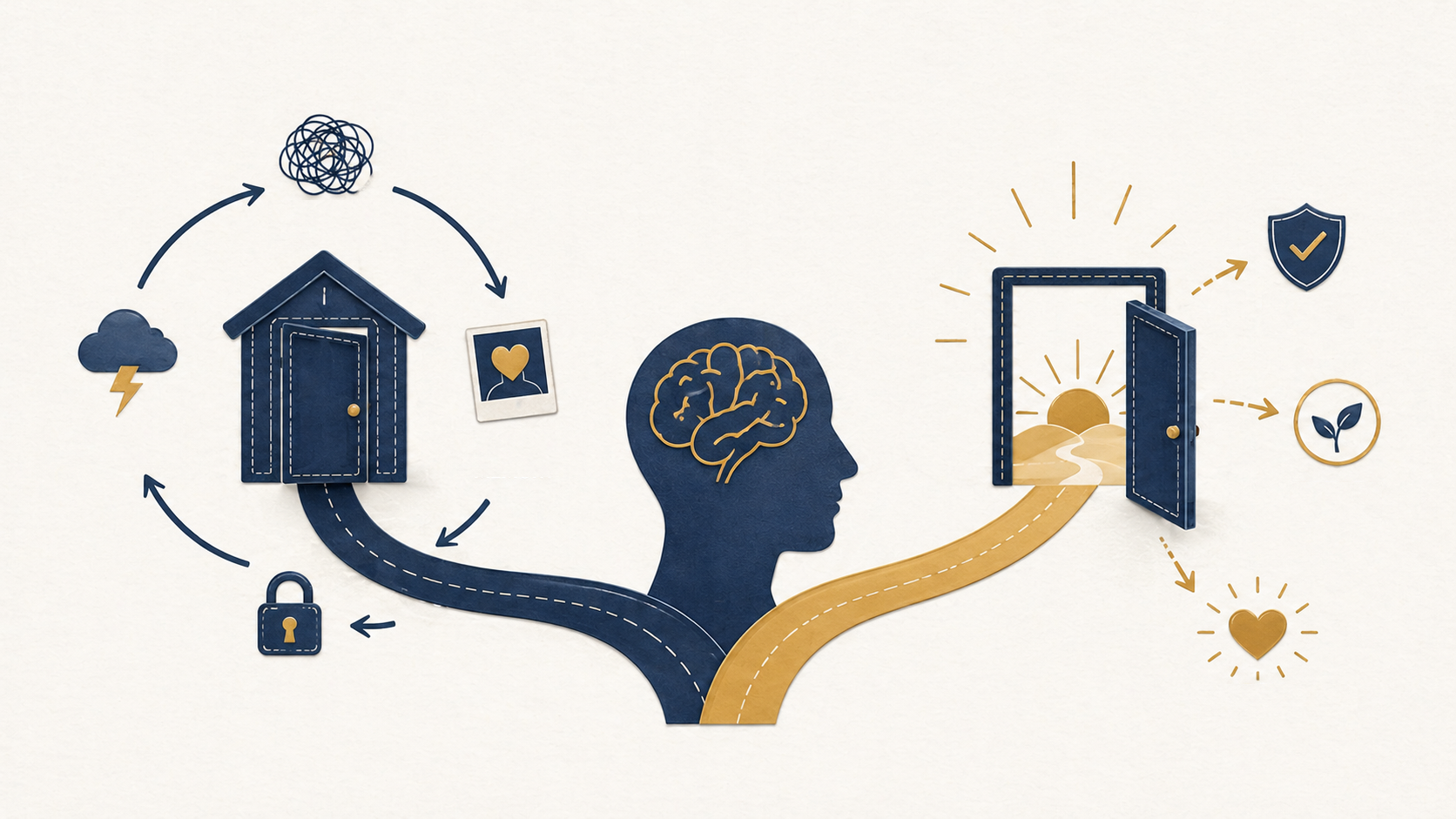
How fear, habit, and emotional memory can keep us attached to what no longer helps us
Many people assume that the mind naturally moves towards what is good for us and away from what is painful. It would be lovely if that were true. It would also save a great deal on therapy, awkward self-reflection, and late-night regret.
In reality, the brain often prefers what is familiar over what is healthy. Even when a pattern causes distress, the fact that it is known can make it feel safer than change. This does not mean the brain enjoys suffering. It usually means the brain is trying to reduce uncertainty and preserve predictability. Research on uncertainty and stress suggests that uncertainty itself can be experienced as threatening, and that the brain plays a central role in deciding what counts as threat in the first place.
The brain values familiarity
One helpful way to understand this is to remember that the brain is built not only to seek pleasure, but also to predict what is coming next. Predictability gives the nervous system a sense of order. Familiar patterns, even unpleasant ones, are easier to map than situations that are new, unclear, or difficult to read.
This matters, because uncertainty is not emotionally neutral. A major review in Nature Reviews Neuroscience argued that uncertainty about possible future threat is a central driver of anxiety. Another review described intolerance of uncertainty as a tendency to experience uncertain situations as threatening, regardless of the actual level of danger. In plain English, the brain often treats the unknown with suspicion. It is not always being dramatic. Sometimes it is simply being cautious in the most old-fashioned way possible.
So, when a person remains attached to an old pattern, the question is not always, ‘Why are they choosing pain?’ Sometimes the more accurate question is, ‘Why does this feel more predictable than the alternative?’ That is a very different question, and usually a much kinder one.
Why familiar pain can feel safer than unfamiliar peace?
This is the emotional centre of the issue. People may return to old habits, relationships, environments, or ways of thinking even when they suffer in them. They may stay in a dynamic that leaves them anxious, defensive, or diminished. They may keep using the same coping style even after it has plainly stopped helping. From the outside, this can look irrational. From the inside, it often feels more like survival.
The familiar comes with a script. You may not like the role, but you know the lines. Unfamiliar peace, by contrast, can feel unstructured. It asks the brain to tolerate uncertainty, loosen old expectations, and trust that a different outcome is possible. That is not always easy. Especially when someone has spent years learning that the world is unpredictable, relationships are unsafe, or calm never lasts very long.
The neuroscience of habits helps explain part of this pull. A major review in the Annual Review of Psychology describes habits as behaviours that become linked to recurring contexts through repetition. Over time, the brain becomes efficient at repeating familiar responses in familiar settings. That efficiency can be useful when the habit is healthy. It can be rather less charming when the habit is self-defeating. The point is that repetition matters. The brain gets quicker at what it does often.
The role of fear, habit, and avoidance
Fear and habit often work together. When something is uncertain, the brain may lean towards what is known. If that choice lowers tension in the short term, even briefly, the pattern is more likely to repeat. This is how avoidance can quietly become powerful. It may not solve the problem, but if it reduces distress for a moment, the brain takes note.
Research on avoidance learning suggests that avoidance behaviours can be reinforced because they reduce or prevent an aversive state. More recent reviews also note that avoidance can become habitual over time, especially when it is repeated often enough. In other words, the mind may learn that familiar discomfort is easier to manage than unfamiliar change, not because it is good, but because it feels more controllable.
This helps explain why people sometimes keep circling the same problem. They are not necessarily choosing it in any deep philosophical sense. They may simply be choosing the option that asks the least from an already burdened nervous system. If the new path requires uncertainty, exposure, conflict, or grief, the old one may feel easier to tolerate, even when it hurts.
Trauma and emotional memory
This becomes especially important in the context of trauma.
When someone has lived through repeated stress, neglect, or threat, the nervous system may adapt around those experiences. Over time, heightened alertness can begin to feel normal. Calm, by contrast, may feel unfamiliar, difficult to trust, or oddly exposed. I say this cautiously, because it does not happen in the same way for everyone. But the clinical literature on trauma does support the broader idea that extreme stress can leave lasting effects on brain function, threat sensitivity, and bodily arousal.
This is where emotional memory matters. Research suggests that emotionally arousing experiences are often encoded and consolidated differently from neutral ones, with the amygdala playing an important role in strengthening memory for emotionally significant events. That does not mean every painful memory becomes fixed forever. It does suggest, however, that repeated distress can leave a strong imprint on how the brain reads future situations. The brain may begin to expect danger sooner, settle more slowly, and treat familiar distress as easier to understand than unfamiliar ease.
So, when someone says, ‘I know this is not good for me, but it still feels safer than change’, that is not always poor insight. Sometimes it reflects a nervous system that has been trained, through experience, to trust vigilance more than ease. Very often, it is the brain trying to protect the person with old rules that once made sense. Those rules may now be outdated, costly, or unhelpful. But the brain does not update itself just because we have had a brilliant insight in the shower. It usually needs repetition, safety, and experience before it starts to trust a new pattern.
Learning That New Can Be Safe
The brain prefers familiarity for understandable reasons. Familiar patterns are easier to predict. Habits reduce effort. Avoidance can bring short-term relief. Emotional memory can keep old meanings alive long after the original situation has changed. The nervous system, especially after repeated stress, may become more prepared for danger than for peace. None of this means change is impossible. It only means that change usually asks more from us than a slogan can capture.
Recovery, then, is not only about wanting better. It is also about teaching the brain that what is new can be safe, and that what is familiar is not always what we need.
Further reading
This article draws on research in psychology, neuroscience, habit formation, trauma, and emotional memory. For readers who would like to explore the subject in more depth, the following sources may be helpful:
Uncertainty and anticipation in anxiety
https://pmc.ncbi.nlm.nih.gov/articles/PMC4276319/The neuroscience of habits
https://www.annualreviews.org/content/journals/10.1146/annurev-psych-122414-033417Avoidance learning and its role in behaviour
https://pubmed.ncbi.nlm.nih.gov/27752080/How trauma affects the brain and body
https://journals.physiology.org/doi/abs/10.1152/physrev.00041.2006Emotional memory and the amygdala
https://pubmed.ncbi.nlm.nih.gov/15217324/
Note: Some concepts in this article are simplified to make the science easier to understand without changing the main message.
